



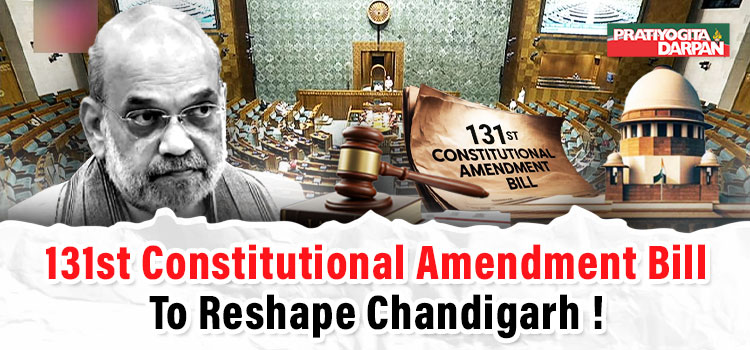
131st Constitutional Amendment Bill: Major Shift Ahead for Chandigarh’s Administration!
131st Constitutional Amendment Bill to Reshape Chandigarh !
The Constitution (131st Amendment) Bill, 2025, which has recently gained attention, proposes a major change in the governance of Chandigarh by bringing it under the purview of Article 240 of the Constitution. Currently, Chandigarh functions as the joint capital of Punjab and Haryana and is administered as a Union Territory (UT). Administratively, the city falls under the Governor of Punjab, even though it does not have its own legislative assembly. The day-to-day governance of Chandigarh is managed by the Chief Secretary, Finance Secretary, and other Union Territory officials, making it unique among Indian cities.
If the amendment is implemented, a separate Administrator or Lieutenant Governor could be appointed specifically for Chandigarh, which would effectively end the role of the Punjab Governor in the city’s administration. More importantly, the amendment would empower the President of India to directly frame rules and regulations for Chandigarh, giving these rules the same effect as laws passed by Parliament. This provision would allow the President to intervene directly in the city’s legal and administrative framework, a power not exercised in the current governance structure.
The proposed changes represent a significant departure from Chandigarh’s existing model, which balances its role as a shared capital with centralized administrative control. By granting the President direct legislative authority and introducing a dedicated Administrator, the amendment could reshape the administrative hierarchy, streamline decision-making, and potentially bring greater efficiency to governance. However, it also raises questions about centralization of power and the future role of state governments in the city’s administration.
Overall, if enacted, the 131st Amendment would mark a historic shift in Chandigarh’s governance, transforming it from a unique hybrid system into a more centrally controlled Union Territory with direct presidential oversight. This could have long-term implications for administrative policies, urban planning, and the balance of authority between the Centre and the states.