



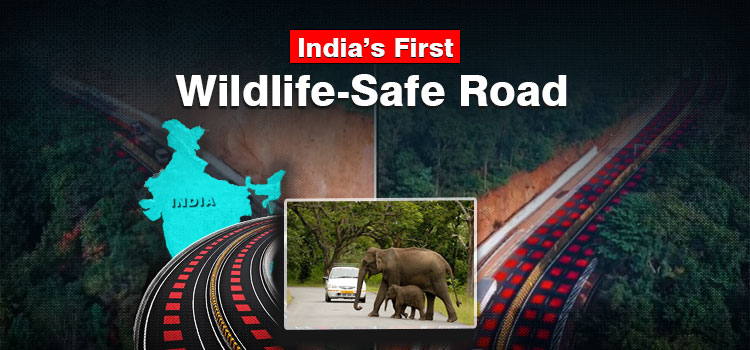
India’s First Wildlife-Safe Road Launched on NH-45
India’s First Wildlife-Safe Road Launched on NH-45
National Highways Authority of India (NHAI) has taken a landmark step toward environmentally sensitive infrastructure by developing India’s first wildlife-safe road on National Highway–45 in Madhya Pradesh. This pioneering initiative reflects a growing recognition that infrastructure development must progress in harmony with ecological conservation.
The project has been implemented on a 2 km ecologically sensitive ghat section within the 11.96 km long Hiran–Sindoor stretch of the Bhopal–Jabalpur route. This segment lies close to the Veerangana Durgavati Tiger Reserve, formerly known as the Nauradehi Wildlife Sanctuary, a region known for frequent wildlife movement across the highway.
A key feature of this wildlife-safe corridor is the use of 5 mm thick raised thermoplastic “table-top red markings” on the road surface. These markings act as visual and tactile cues for drivers, encouraging them to slow down smoothly without causing discomfort or sudden braking. By naturally moderating vehicle speed, the risk of animal–vehicle collisions is significantly reduced.
In addition, 25 dedicated wildlife underpasses have been constructed to allow animals to cross the highway safely along their natural movement paths. The corridor is further secured with 8-foot-high fencing on both sides, guiding wildlife toward safe crossing points and preventing accidental entry onto fast-moving traffic lanes. Advanced speed detection devices and surveillance cameras have also been installed to ensure compliance and continuous monitoring.
With an estimated investment of ₹122 crore, this project aligns with NHAI’s Green Highway Initiative, which emphasizes sustainability, safety, and environmental responsibility. If proven successful, this innovative model is expected to be replicated across other national highways in India, setting a new standard for balancing infrastructure growth with wildlife conservation.